


Ocean scientist Milan Curcic, PhD, had spent 15 years studying waves when a conversation in his office helped sharpen a question that had been lingering in the back of his mind for years. What happens when hurricane-force winds become strong enough to shear the tops off steep ocean waves?
Curcic began sketching the concept on a whiteboard as he and a colleague visiting from Japan exchanged ideas. “I asked him what he thought, and he said, ‘Yeah! Go for it!’” said Curcic, who holds a joint appointment as a core faculty member at the Frost Institute for Data Science and Computing (IDSC) and an Assistant Professor at the Rosenstiel School of Marine, Atmospheric, and Earth Science. “These kinds of meetings and conversations can sometimes be serendipitous, providing an idea or the encouragement to pursue something that I otherwise might not.”
The conversation crystallized a new research direction. Curcic calls the concept “wave tearing,” a process that has been observed before but never systematically measured. It became the focus of a proposal that won him a prestigious National Science Foundation CAREER Award.
“I still can’t believe it!” he said. For Curcic, wave tearing represents new territory. “This specific wave-tearing process is new, and we are the first ones to do it,” he said. “It hasn’t been measured before.”
Investigating Waves to Better Predict Hurricanes
The award will allow Curcic to investigate a small-scale ocean process that could have significant implications for scientists’ understanding and prediction of hurricanes.
Curcic studies the physics of ocean waves: how they grow under the force of wind, how they move, and how they break. They generate ocean currents and turbulence below the surface while also creating friction for the atmosphere above, Curcic explained.
His CAREER project focuses on what happens when extremely strong winds encounter very steep waves. Under hurricane-force conditions, Curcic said, wind can shear the tips from the wave crests. “It’s not a traditional wave-breaking mechanism,” he said. The process occurs on a small physical scale, but it could affect how scientists simulate the evolution of an entire hurricane.
Ocean waves make the sea surface rougher, increasing friction between the ocean and atmosphere. But when strong winds tear away the tips of steep waves, they may smooth the surface. A hurricane moving over that smoother, more “slippery” surface could lose less mechanical energy to the ocean than current models assume.
“The hurricane as a whole will have a chance to strengthen,” Curcic said. His research will help determine how significant that effect is for hurricane intensity.
Bringing the Hurricane to the Lab
Measuring wave tearing in the open ocean during a hurricane would be extremely difficult. Instead, Curcic brings the hurricane conditions into the lab.
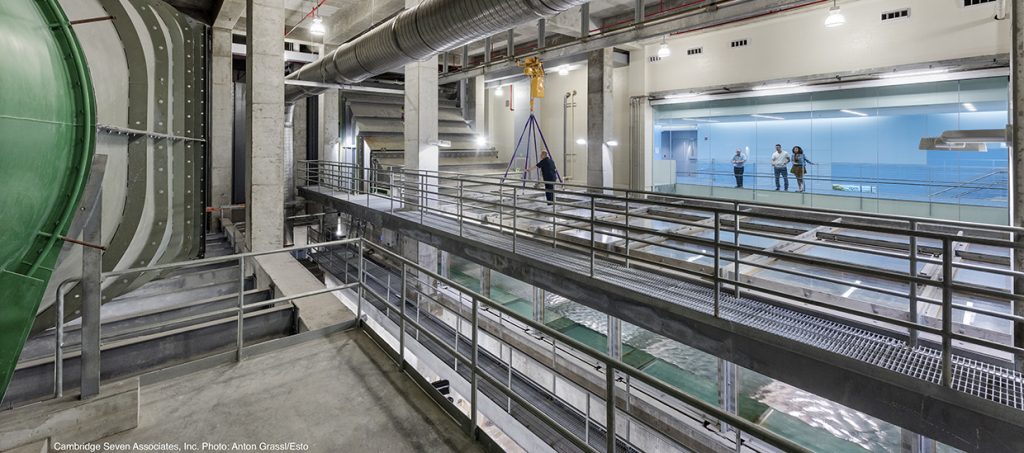 At Rosenstiel, the SUSTAIN wind-wave tank allows researchers to generate powerful winds over controlled waves. Curcic can adjust the wave conditions and wind speed, positioning instruments exactly where measurements are needed.
The tank is transparent, allowing him to observe the water from multiple angles. Using high-speed cameras and LED panels, Curcic will capture the moment a wave crest breaks apart, revealing details smaller than a millimeter. The cameras will record more than 100 images per second, allowing him to watch the crest detach and fragment into increasingly small droplets. He will connect these images to measurements of wind, turbulence, and wave shape
 The first goal is to identify the ingredients required for wave tearing. How strong does the wind need to be? How steep does the wave need to become? He expects the process to emerge somewhere around the transition between tropical-storm and Category 1 hurricane winds, but the experiments are designed to replace rough observation and intuition with measurable thresholds.
He also wants to determine the rate of tearing, meaning how much of the wave and its energy are actually blown away. He estimates the energy loss might reach 10 to 20 percent under some conditions, but the experiments will allow him to put a precise number on it.
The detached water might create another important effect. As the crest breaks apart, it produces spray and large airborne droplets known as spume. Because sea spray can affect turbulence near the ocean surface, measuring it could reveal another way wave tearing changes the interaction between a hurricane and the ocean underneath it.
Turning Waves into Equations
The cameras will show Curcic what wave tearing looks like. His next task will be turning those observations into mathematics. Using data from the lab, he plans to develop a unified model that predicts whether tearing will occur under a given combination of wind speed and wave steepness. When it does, the model will estimate how rapidly energy is removed from the wave. That model can then be turned into computer code and added to the numerical systems scientists use to simulate hurricanes.
He plans to run simulations of selected storms twice, once with wave tearing included and once without it. Comparing the results will allow researchers to quantify how much the process changes a hurricane’s simulated development.
The approach brings together the different strands of Curcic’s career. He began studying wind-wave interactions through computer modeling, later added lab measurements, and eventually combined the two.
Extending the Work Beyond his Lab
NSF CAREER Awards are designed to support both research and education, and Curcic’s project extends well beyond the wave tank. He will transform his existing lecture notes, Fluid Mechanics for Atmosphere and Ocean Scientists, into a polished, openly available interactive textbook.
Rather than relying only on traditional text and exercises, the book will include web-based simulations where students will be able to adjust the parameters in an equation and immediately see how a simulated wave responds. They will be able to interact directly with a wave and observe how their actions change those parameters.
Curcic believes that two-way interaction can help students understand concepts that may be difficult to grasp through equations alone. The award also supports a five-year mentorship program with East Hampton High School in New York, where Curcic already works with students. Through the school’s research program, students are paired with university professors and guided through individual science projects. Two students have already visited Curcic’s lab and helped collect measurements. One is now working with him on a peer-reviewed paper related to wave science.
The larger goal of Curcic’s work is to improve understanding of the physical processes that shape hurricanes and, eventually, help improve forecasts and reduce risks to coastal communities. Curcic doesn’t suggest wave tearing alone will solve the challenge of hurricane forecasting. Instead, he compares it to assembling a jigsaw puzzle. “The more pieces you fill in, you get a better idea for the rest and where the missing pieces will go,” he said.
Curcic hopes his work will help scientists better understand the underlying physics that influence how powerful storms develop, adding another piece to the puzzle of how hurricanes behave and how accurately they can be predicted.
__________
Story by Lauren Comander | Read More: The Fluid Dynamics That Charted Milan Curcic’s Career