


Artificial intelligence is often thought of as the expert. Wanli Xing is flipping the script.
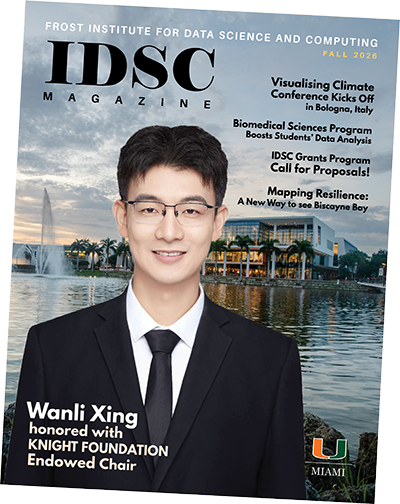 In his largest research project to date, the Frost Institute for Data Science and Computing (IDSC) AI and Machine Learning core faculty member and professor in the School of Education and Human Development is having middle school students teach math to an AI agent. The student becomes the teacher, and the AI agent becomes the learner.
For Xing, recently named the John S. and James L. Knight Foundation Chair in Artificial Intelligence at IDSC, that reversal connects two themes in his work: strengthening students’ ownership of learning and rethinking the dominant role AI often plays in educational technology.
Xing said the Knight Chair gives him additional resources and flexibility to explore new research directions while opening opportunities to collaborate across the University and beyond.
“It’s such an honor,” he said.
AI research can be expensive, requiring computing resources as well as the people and infrastructure needed to develop new systems.
Education research adds another layer, with researchers traveling to schools, working directly with teachers, conducting interviews, and testing technology in classrooms.
The appointment comes at a pivotal moment in one of Xing’s most ambitious projects.

Students Learn by Teaching
The project, called ALTER-Math, is a $10 million initiative funded by the Learning Engineering Virtual Institute that focuses on middle school mathematics and is grounded in the concept of learning by teaching. Students at that age, Xing said, may begin to decide they are “not good at math,” making them less likely to pursue more advanced math later.
 He also sees limitations in how students can experience math in traditional classrooms. They may memorize a formula without understanding why it works or how it applies and can lose engagement, ownership, and agency in the learning process.
Learning by teaching offers another approach. The premise is simple: teaching a concept to someone else can strengthen the teacher’s own understanding. Xing said research has found positive effects on both student engagement and learning outcomes.
Putting that approach into practice in a classroom can be challenging, Xing said, particularly with one teacher and 20 to 30 students. Generative AI offered Xing and his team another possibility. They created an AI agent that plays the role of a student. After students learn a math concept from their teacher, they teach it to the AI agent.
“The students become the teachers, and the AI agent becomes the student,” he said. That simple change represents something larger to Xing. Much of the work in generative AI, he said, treats artificial intelligence as the more knowledgeable participant. “AI plays the role of the expert and shapes the learner’s path and choices,” he said.
From Prototype to Classrooms
The project is now in its third year, with two years remaining. Xing and his team spent much of the first two years building and refining the AI agent, testing it with students and teachers, incorporating expert feedback, and adjusting the system. Now, Xing said, the technology has reached a stage where the team can begin evaluating it at a much larger scale.
The project has already reached tens of thousands of students, primarily in Florida, and the team aims to reach about 200,000 students over the next two years. Researchers are also preparing a large-scale evaluation involving 150 teachers across more than 50 schools in multiple Florida school districts.
The trial will examine how the AI system affects students’ learning experiences, engagement, and learning outcomes.
“We feel like it’s ready for this next stage of large-scale evaluation,” he said.

AI in the Role of Student
Making AI act like a student presents unique technical problems.
A large language model already contains enormous amounts of information, but within this project, the AI agent is supposed to act like the only thing it knows is what the student has taught it. If the student hasn’t taught the AI about inequality, the AI should not suddenly demonstrate knowledge of that concept just because the underlying language model already knows it. Xing describes this as a form of “pedagogical hallucination.”
“A knowledge graph gives the AI
a basic understanding of how
students typically struggle with math.”
His team addresses that problem with an external knowledge structure (known as a knowledge graph in the AI community). They use a large amount of past question-and-answer data between students and human tutors on an online math platform to identify common mistakes and challenges that students face in learning math. These patterns are organized into a knowledge graph that gives the AI a basic understanding of how students typically struggle with math. As students interact with the AI, the knowledge graph updates based on what the student has actually taught the AI. Xing compares it to a human student answering a question using both memory and a notebook, with the language model’s built-in knowledge serving as the memory while the external knowledge structure acts as the notebook, recording what the student has actually taught.
Another challenge is generating math problems across a wide range of middle school concepts and standards. Creating them manually would be difficult to scale, but simply asking a large language model to generate them does not reliably work either. Xing said generated problems can contain errors or contexts that do not make sense.
His team has developed more structured approaches to generating and validating problems, including systems that combine AI with human review.
Teachers Remain Central
Despite assigning AI the role of student, Xing is clear about the importance of the human teacher. “We’re not replacing teachers,” he said. Students must understand a concept before they can teach it. Teachers still introduce and explain the material, while the AI exercise gives students another way to reinforce what they have learned. Teachers can monitor student interactions through a dashboard. If the system identifies a pattern, such as too many students struggling to explain the same math idea, the teacher can revisit it with the class. The dashboard also gives teachers oversight of student interactions with the AI agent as part of the project’s approach to safety.
Feedback has helped shape the technology. Early on, students said interacting with the AI felt like talking to a bot, prompting the researchers to introduce different styles and personalities for the agents. The AI also, initially, produced responses that could stretch to 10 to 15 sentences, too long for many middle school students. The team worked to simplify interactions and added elements like images and drawings. Teachers also helped shape the dashboard. “The stakeholders become the co-designers,” Xing said.
A Broader Vision for AI and Learning
The middle school math project is part of a larger research agenda for Xing. While one side of his work focuses on creating AI tools that support teaching and learning, the other asks how students themselves can learn about artificial intelligence and advanced computing.
 Xing is involved in projects exploring how AI and machine-learning concepts can be incorporated into subjects that students already take, including math. He also is working on projects with Florida Virtual School, bringing advanced computing into undergraduate engineering education, and integrating computing and music for elementary students.
That broader agenda is expanding through MAGICAL-Math (Multimodal Artificial Generative Intelligence Championing Advanced Learning Sciences for Math Education), a new project supported by $3.75 million from the U.S. Department of Education’s Institute of Education Sciences and additional industry funding, bringing the total to more than $4 million.
As principal investigator, Xing will lead a multidisciplinary team bringing together expertise in artificial intelligence, mathematics education, learning sciences, and educational technology to explore a new generation of AI-supported mathematics learning environments. The project builds on a central idea running throughout Xing’s work: educational AI should be designed around how students actually think and learn, rather than simply around what AI is capable of doing. While ALTER-Math explores an unconventional model in which students teach AI, MAGICAL-Math extends that approach by investigating how advances in generative AI can be combined with established principles from the learning sciences to create more adaptive and meaningful learning experiences. The project will also study how these approaches work with students and teachers in authentic educational settings.
Among those efforts, ALTER-Math stands out for both its scale and its potential student impact, and it is especially meaningful to him. He credits a team that includes AI engineers, postdoctoral researchers, doctoral students, collaborators, and consultants. As principal investigator, he oversees its direction.
“I’m very proud of this,” he said.
For Xing, ALTER-Math and MAGICAL-Math are part of a larger goal: moving beyond simply adding AI tools to classrooms and instead rethinking how students, teachers, and AI can work together to support learning.
__________
Story by Lauren Comander