


As artificial intelligence (AI) races ahead, Andres Sawicki is examining the rules being written around it. Who owns what AI creates? Who is responsible when it causes harm? How should institutions respond as the technology becomes more embedded in everyday life?
 Some of the answers are buried in the terms of service that everyone who uses generative AI agrees to—but almost no one reads.
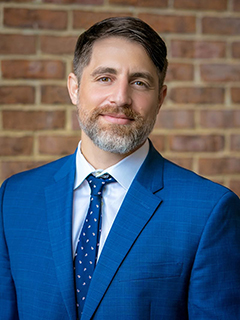
Through new research, faculty recruitment, and interdisciplinary programming, Sawicki, director of the Data Ethics, and Society program at the University of Miami Frost Institute for Data Science and Computing (IDSC) and professor at the School of Law, is reading the fine print. His work examines not only what increasingly powerful AI systems can do, but how their rapid adoption is changing the legal and social landscape around them. At the same time, he is helping the University build a community of scholars equipped to tackle the questions AI is creating.
“There are obviously a lot of really important technological breakthroughs,” Sawicki said. “But I think it’s equally important for us to think about how these technological breakthroughs will change the way we live.”
Reading the Fine Print
 Sawicki’s recent research, which grew out of an IDSC grant supporting work in generative AI, focuses on an area that has received far less attention than the technology itself: the terms and conditions governing generative AI platforms. Along with former University of Miami colleague John Newman, an antitrust scholar who studies digital platforms, Sawicki collected and coded the terms and conditions of 86 platforms, studying issues including ownership of inputs and outputs, licensing, liability, and dispute-resolution provisions. They began collecting data in 2025 and published their analysis this summer.
They found good news and bad news, Sawicki said. The encouraging result was that in the overwhelming majority of cases AI providers did not claim ownership of users’ outputs. The agreements generally say that users keep whatever copyright interests arise in material created using AI tools.
The more concerning finding involved liability. Many AI providers include indemnification provisions in their agreements that shift legal risk from providers to users. If generated content leads to a copyright infringement claim, for example, some terms demand that users cover the provider’s liability. Such provisions can make sense in more traditional settings, Sawicki said, where a company might reasonably expect an author to take responsibility for material they write. Generative AI creates a different dynamic because users do not fully control what a system produces.
The next phase of the research, supported by additional funding from the Washington Center for Equitable Growth, examines the competitive implications of AI terms of service, including provisions that may restrict users from using one AI system to develop a competing product.
Building Expertise Across the University
 Sawicki’s research represents only one part of his work through IDSC. He is also helping build a community of scholars examining the ethical, legal, and social implications of AI and data science. While serving on the Law School’s appointments committee, Sawicki saw an opportunity to use his dual roles as an IDSC program director and law professor to recruit faculty whose work could contribute to both. “I saw an opportunity for us to recruit some very high-level candidates who could contribute both on the law school side and on the IDSC side,” he said.
One of those recruits was Thomas Kadri, whose research includes online privacy and government use of artificial intelligence. Sawicki said he pushed for candidates whose interests spanned both areas.
 Looking ahead, Yonathan Arbel, another scholar working at the intersection of law and artificial intelligence, is a visiting professor at the University this year and is expected to join the faculty permanently in the 2027-2028 academic year.
Sawicki sees these hires as part of a larger effort to build what he calls a “critical mass” of scholars examining distinct-but-related questions from different perspectives. Those questions include who should be liable when AI technologies cause harm, who gets to benefit from what they make possible, and whether those benefits will be equitably distributed across society or captured by a relatively small number of people.
Law is one of the primary disciplines wrestling with those issues, Sawicki said, and the School of Law already has faculty working in related areas. His own research focuses on intellectual property, while Kadri approaches technology through privacy and torts, and Arbel examines corporate and governance questions, including how AI might be regulated to address existential risks.
The next phase, Sawicki said, is to build that capacity across the University by bringing in perspectives from fields like sociology, business, philosophy, and political science. “There’s a lot of work to be done in a lot of different areas,” he said. “So, we are building our team.”
Bringing Students into the Conversation
Students will also be part of that effort. Beginning in the spring, IDSC and the School of Law will support a new colloquium on law and artificial intelligence. The weekly workshop will bring in speakers to discuss current research and will include faculty, law students, and graduate students from across the IDSC community. Sawicki sees the colloquium as an opportunity for students at the beginning of their careers to engage directly with researchers and the questions shaping their field.
As AI systems become more powerful and more deeply woven into everyday life, these questions are becoming more urgent. For Sawicki, the challenge is not just keeping pace with what AI can do but understanding what its growing role will mean for people, institutions, and society. Sometimes, understanding it starts with reading the fine print.
__________
Story by Lauren Comander