


Island Wake Dynamics
In the near future, the research could also help fisherman and naval ships to traverse the region with fewer surprises, and it may even aid future hurricane forecasts. “Currently, island wake dynamics are a very small part of forecast models, but they can have a large impact,” said Dawson, who was then in her fifth year of graduate school at the University of Miami, studying with ocean sciences professor Hans Graber.
Dawson’s research, funded by the U.S. Office of Naval Research, was accelerated by her 2023-2024 IDSC fellowship where she worked with two mentors—one from the Rosenstiel School Department of Ocean Sciences and one from IDSC—to utilize new machine learning techniques in order to read satellite images more efficiently. “The IDSC Fellows program helped me understand how to get a machine learning model running and how to decide which was the best computing model to use for this work,” she said, adding that her adviser, Department of Computer Sciences Associate Professor and IDSC Core Faculty Member David Chapman, was extremely helpful.
IDSC Fellows Program
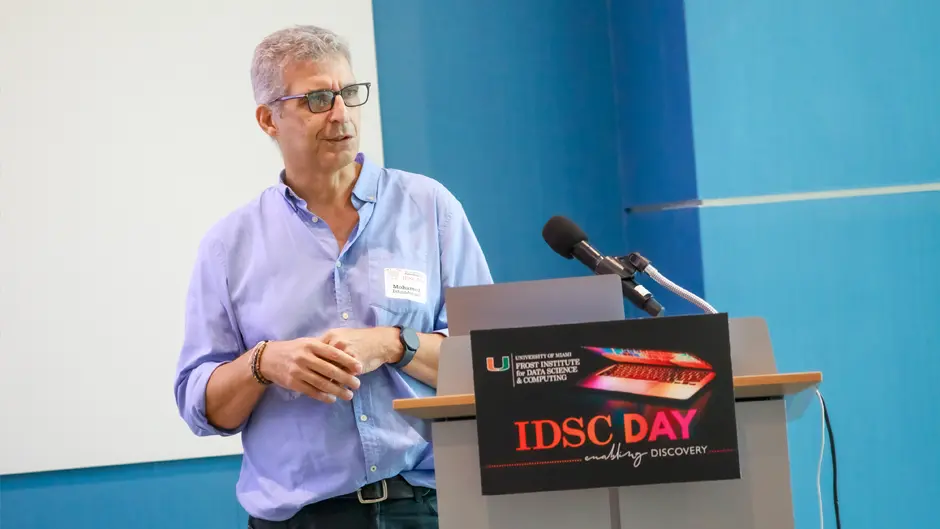
Other IDSC Fellows have used advanced technology to help identify how tumors evolve on the eye, to better understand how Alzheimer’s disease spreads, and one Fellow even created a tool that could help psychologists diagnose autism more efficiently. “Ultimately, we offer this fellowship because we want students to see how computational science can benefit the discipline they are in, and how new algorithms developed by computer scientists can be applied to other subject areas and problems,” said Mohamed Iskandarani, professor of ocean sciences and chair of the IDSC Fellows Program Steering Committee that selects the fellows. “It’s a great opportunity to propel your career forward.”
Powering Student Research
Each year, students apply in the fall semester and, when chosen as IDSC Fellows, are notified in early November. They will then be paired with an IDSC core faculty member (in addition to their subject area mentor) to help identify the ideal algorithms or software for their work, as well as which of the University’s two supercomputers—Pegasus or Triton—they may want to utilize to start their work. “Their mentor should help them overcome hurdles that prevent them from taking their research to the next level,” Iskandarani added.
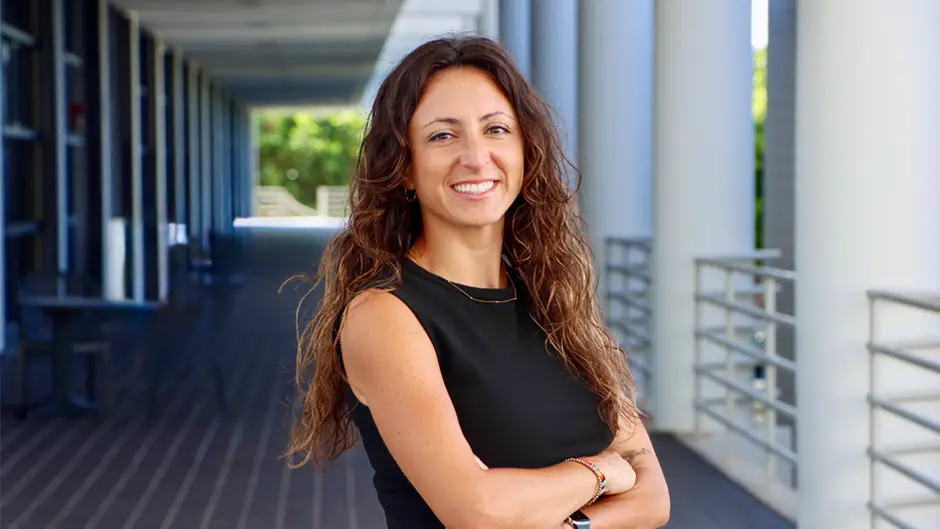
Marybeth Arcodia, a current IDSC Core Faculty Member and assistant professor of atmospheric sciences, helped to mentor junior Nimay Mahajan last year when he was an IDSC Fellow. Mahajan was working on a project to understand the relationships between Indian monsoons and Atlantic Ocean hurricane development, and he is now working on a senior thesis with her. Arcodia said the IDSC Fellowship is ideal for students interested in using data science to improve their research.
“AI, machine learning, and data science have garnered a lot of excitement, so students are eager to get involved in this work—but they often don’t know how,” said Arcodia, who is also an alumnus of the Rosenstiel School of Marine, Atmospheric, and Earth Science. “This fellowship provides a pathway to bridge that gap and to help expose students to big data and to machine learning for whatever topic they are interested in.”
Learn more about IDSC Fellowships
__________
SOURCE: NEWS@TheU article by Janette Neuwahl Tannen
HEADER PHOTO: Madeleine Dawson, along with her IDSC mentor professor David Chapman, and computer science graduate student Parniyan Farvardin, at IDSC Day on campus last spring. The trio authored a paper that Dawson presented this summer in Australia, which explained how they created a computerized model for measuring winds around Caribbean islands using satellite aperture radar images. Photo courtesy of Madeleine Dawson.